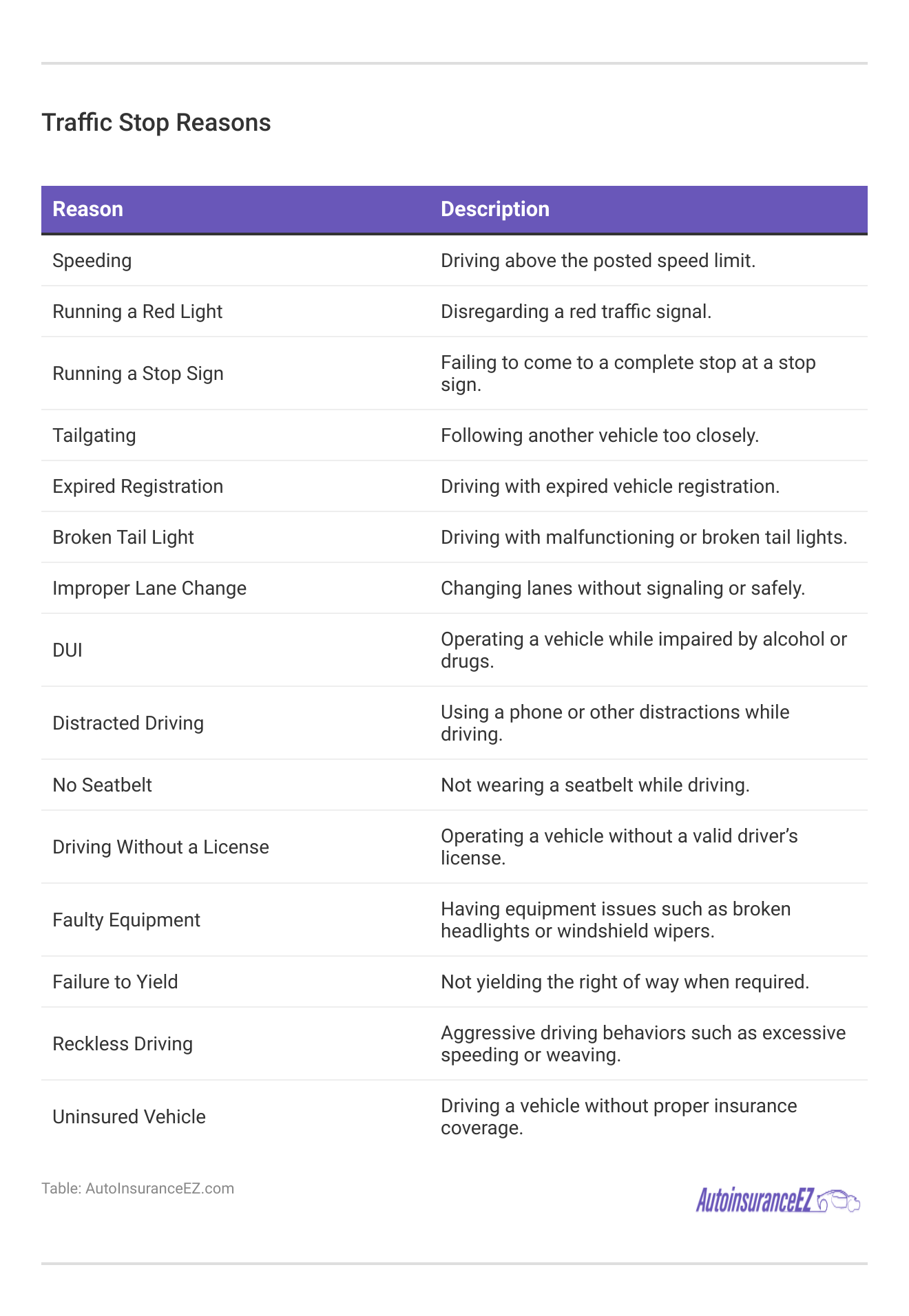
Top 10 Traffic Stop Reasons in 2026 (Every Driver Should Know)
Knowing the top traffic stop reasons can help you avoid violations. Speeding, which accounts for 41% of stops, is a common cause. Data also shows Hispanic drivers are more likely to receive a ticket than a warning compared to white drivers. Read on to learn how to avoid getting pulled over.
Read more Secured with SHA-256 Encryption






Find the Lowest Car Insurance Rates Today
Quote’s drivers have found rates as low as $42/month in the last few days!




Table of Contents
Table of Contents

Insurance and Finance Writer
Laura Gunn is a former teacher who uses her passion for writing and learning to help others make the best decisions regarding finance and insurance. After stepping away from the classroom, Laura used her skills to write across many different industries including insurance, finance, real estate, home improvement, and healthcare. Her experience in various industries has helped develop both her ...
Laura Gunn

Licensed Insurance Agent
Brad Larson has been in the insurance industry for over 16 years. He specializes in helping clients navigate the claims process, with a particular emphasis on coverage analysis. He received his bachelor’s degree from the University of Utah in Political Science. He also holds an Associate in Claims (AIC) and Associate in General Insurance (AINS) designations, as well as a Utah Property and Casual...
Brad Larson
Updated November 2024
Discover the top traffic stop reasons that could land you pulled over. Check our guide to driving violations to learn how to avoid common mistakes.

Despite safer technology, driving risks remain. In 2017, the NHTSA reported 37,133 fatalities. Traffic stops aim to ensure safety, and violations may lead to high-risk auto insurance. Reduced stops during COVID-19 might lower rates. To save on insurance, compare quotes using our free tool by entering your ZIP code.
In this article about traffic stops, we’ll also cover the following topics: traffic stop questions, what is a traffic stop, what is a routine traffic stop, and the meaning behind a traffic stop. Let’s get started. For more information, read our “Driving Tips for Road Safety“.
- Learn top traffic stop reasons to understand what draws police attention
- Learn how violations like speeding and equipment issues trigger traffic stops
- Find out how to avoid unnecessary encounters with law enforcement
Demographics of Drivers Most Likely to Be Pulled Over by the Police
Sometimes, police officers driving in obvious police cars with blue and white lights attached to the roof of the car are the ones who do the traffic stops. However, more and more police departments have started using an unmarked police car to pull over unsuspecting drivers.
However, certain demographics have more chances of getting pulled over by police than others, and the consequences for drivers who are subject to a traffic stop vary significantly.
According to the Department of Justice, there are 19 million traffic stops per year. The data shows that African Americans are more likely than other racial groups to be pulled over, with 9.8% of Black drivers experiencing a traffic stop annually.
Our traffic stop data, including Department of Justice statistics, helps rank traffic stop reasons and analyze demographic differences, though racial profiling is not the main focus of this article.
The data also shows that women are less likely than men to be pulled over. In addition, 18-24-year-old young drivers are the most likely age group to have a police-initiated traffic stop, with the likelihood steadily decreasing with age. Since drivers under the age of 25 are less experienced behind the wheel, they often also pay higher insurance rates. Not all drivers who are pulled over believe that their stop was justified. In fact, only 80.6% of all traffic stops are perceived by drivers to have a legitimate cause.
Not surprisingly, drivers are more likely to perceive the stop as legitimate when police officers provide a reason for the stop (83.7% compared to 36.7%). Among all traffic stops, police officers provided a reason for the stop in 95.4% of cases.
Black drivers are the largest racial group to be pulled over, which contributes to the financial burden of driving while Black in 2019, which includes higher insurance premiums and reduced mobility.
Department of Justice data shows that police are more likely to give women a reason than men, and police are less likely to give Hispanics a reason than other racial groups, which puts the onus on Hispanic drivers to know their legal and auto insurance rights.
Additionally, both Black drivers and Hispanic drivers are significantly less likely to believe they were pulled over justly even when the police officer provides a reason. The outcomes of traffic stops vary by demographics as well. Among all traffic stops, only 12.7% resulted in no enforcement action. Instead, 36.1% of traffic stops led to a warning, 48.8% resulted in a ticket, and 3.7% ended in search or arrest.
It is well known that traffic violations increase auto insurance rates. (note: enforcement actions may not sum to total as respondents may be in more than one category).
While Black drivers and white drivers have similar results from traffic stops, Hispanics are more likely than other races to get a ticket and less likely to get a warning. Hispanics are also the least likely racial group to have no enforcement action taken.
Since auto insurance rates are partially based on driving records, consequences such as getting a ticket or an arrest could also lead to higher premiums, raising the financial burden of driving for certain demographic groups.
Fortunately, there are insurance companies that forgive traffic violations, including those that won’t raise rates for minor driving infractions like traffic tickets.
 In recent years, a growing body of research has investigated the effectiveness of body cameras in police-initiated contact, such as traffic stops.
In 2016, only 47% of law enforcement agencies used body-worn cameras (BWCs), accounting for 119,000 BWCs nationwide. Among law enforcement agencies that use BWCs, more than 90% require their officers to turn the cameras on during traffic stops.
While there is currently no federal law governing the use of body cameras in police-community encounters like traffic stops, several state and local governments have passed legislation regarding their use in an effort to improve police and civilian safety, professionalism, and fairness.
Although some of these may have had an effect, many police departments still employ tactics that target minorities and often lead to a disproportionate amount of discrimination and police on civilian violence.
Speeding remains the top reason for traffic stops, accounting for 40.9% of all stops, highlighting its critical role in enforcing road safety.
Melanie Musson Published Insurance Expert
One of the worst cities for this is Los Angeles, which ranks as our number one city with the greatest potential for reducing its police department budget. It also ranks as the worst city for police department spending per capita out of the 20 most populous cities and largest city police budgets.
Los Angeles PD’s spending per resident is $754, $334 higher than the average for all 150 cities in our sample set.
Now, back to the reasons police officers pull over drivers. We have 10 on the list here and it isn’t exhaustive. The number of reasons officers will pull over drivers is likely incredibly large and relates to all sorts of situations like nighttime driving or speeding through a construction zone.
Officers are especially vigilant during rush hour, as some cities have more rush hour fatal crashes than others especially if they are the worst cities for rush hour fatal crashes. What are the top 10 reasons police officers pull over drivers? Scroll down to find out.
Read more: Types of Auto Insurance Coverage
Free Insurance Comparison
Compare Quotes From Top Companies and Save
Secured with SHA-256 Encryption
Top Reasons Drivers Get Pulled Over
To find the top reasons that drivers get pulled over, our researchers analyzed data from the Department of Justice’s U.S. Bureau of Justice Statistics Police-Public Contact Survey.
In addition to ranking the reasons by how often they occurred, our researchers also analyzed the most likely outcomes (warning, ticket, search/arrest, or no action) and the perceived legitimacy of each reason. Scroll down to see what we found.
Read more: If I want to add a driver or vehicle to my insurance, do I need to start a new policy?
#10 – Roadside Sobriety Check
- Share of All Traffic Stops: 1.4%
- Drivers Perceived Stop to be Legitimate: 78.0%
- No Enforcement Action: 72.1%
- Warning: 18.4%
- Ticket: 4.3%
- Search or Arrest: 8.9%
- Most Likely Outcome: No enforcement action
According to the NHTSA, 10,874 people were killed as a result of drunk driving collisions in 2017. This represents an average of one death every 48 minutes and accounted for 29% of all motor vehicle traffic fatalities in the United States during that year.
Across the U.S., it is illegal to operate a motor vehicle with a BAC of .08 or higher. Roadside sobriety checks aim to reduce the amount of drunk or drug-impaired drivers on the road. Police might pull over a driver who is driving erratically and require him or her to perform a roadside sobriety test, which usually consists of three parts:
- The horizontal gaze nystagmus (HGN)
- The walk and turn
- The one-leg stand
Police will also often use a “sobriety checkpoint,” which is a predetermined location to stop vehicles at regular intervals and perform sobriety tests on the drivers. For about three out of four drivers, roadside sobriety checks will result in no enforcement action. To learn more, read our “Vehicle Insurance“.
#9 – Cell Phone Violation
- Share of All Traffic Stops: 1.7%
- Drivers Perceived Stop to be Legitimate: 74.4%
- No Enforcement Action: 4.1%
- Warning: 22.4%
- Ticket: 73.6%
- Search or Arrest: 0.5%
- Most Likely Outcome: Ticket
Using a cell phone while driving has become a dangerous and all-too-common form of distracted driving.
In 2017, 3,166 fatalities were the result of distracted driving, with 434 of them explicitly linked to the driver’s cell phone use. Despite the prevalence of cellular phones and the role they play in driver distraction, specific laws related to phone use while driving vary widely by state.
For example, some states ban all hand-held phone operations while driving. Other states allow drivers to hold a phone to talk but ban text messaging. State restrictions on cell phone use by junior drivers also vary.
Compared to the other reasons on this list, cell phone violations are least likely to result in an arrest (0.5%) but most likely to result in a ticket (73.6%). About three-quarters of all cell phone violators perceive the stop to be legitimate. To gain further insights, read our “Best & Worst Credit Scores by State“.
Free Insurance Comparison
Compare Quotes From Top Companies and Save
Secured with SHA-256 Encryption
#8 – Police Did Not Give a Reason
- Share of All Traffic Stops: 2.1%
- Drivers Perceived Stop to be Legitimate: 36.7%
- No Enforcement Action: 35.4%
- Warning: 31.0%
- Ticket: 19.8%
- Search or Arrest: 14.5%
- Most Likely Outcome: No enforcement action
When the police do not give a reason for a stop, only 36.7% of drivers perceive the stop to be legitimate.
Violators who are pulled over without knowing the reason are the most likely to be subject to search or arrest (14.5%). The percentage of stops resulting in an arrest when police do not give a reason is about four times higher than the national average.
At the same time, more than a third of drivers who are pulled over without knowing the reason receive no enforcement action.
Read more: Levels of Driving Automation Defined
#7 – Seat Belt Violation
- Share of All Traffic Stops: 3.2%
- Drivers Perceived stop to be Legitimate: 76.4%
- No Enforcement Action: 10.1%
- Warning: 20.0%
- Ticket: 69.9%
- Search or Arrest: 2.2%
- Most Likely Outcome: Ticket
Using a seat belt dramatically reduces the chance of injury in a collision. In 2017, seat belts saved an estimated 14,955 lives. However, only 89.6% of drivers buckle up.
While specific seat belt laws vary from state to state, seat belt violations (not wearing a seat belt when the law requires it) account for 3.2% of all traffic stops.
As you can see in the below news clip, traffic stops for even something as simple as not wearing a seat belt can sometimes have dire outcomes:
Stops due to seat belt violations are more likely to result in a ticket compared to the average for all traffic stops. Nine out of ten seat belt violations result in some form of enforcement action. For more information, check our “Passive Restraint Discount“.
#6 – Multiple Reasons
- Share of All Traffic Stops: 5.8%
- Drivers Perceived Stop to be Legitimate: 84.0%
- No Enforcement Action: 14.3%
- Warning: 37.0%
- Ticket: 45.4%
- Search or Arrest: 8.4%
- Most Likely Outcome: Ticket
Drivers can also be pulled over for multiple traffic violations at one time, such as speeding while not wearing a seat belt, or using a cell phone while running through a stop sign.
Compared to the averages for all traffic stops, drivers who are pulled over for multiple reasons are more than twice as likely to be subject to search or arrest.
Read more: How Traffic Violations Increase Car Insurance Rates
Free Insurance Comparison
Compare Quotes From Top Companies and Save
Secured with SHA-256 Encryption
#5 – Illegal Turn or Lane Change
- Share of All Traffic Stops: 6.8%
- Drivers Perceived Stop to be Legitimate: 75.6%
- No Enforcement Action: 8.0%
- Warning: 45.5%
- Ticket: 45.2%
- Search or Arrest: 2.7%
- Most Likely Outcome: Warning
Not surprisingly, drivers who do not follow the rules of the road are likely to be pulled over. Making an illegal turn (such as a U-turn where a sign forbidding it is posted) or illegal lane change (changing lanes without signaling) accounts for 6.8% of all traffic stops.
Drivers who make an illegal turn or lane change are slightly more likely to receive a warning than a citation with penalties. Only 8% will receive no enforcement action.
Want to learn more about reckless driving? Check out our full guide to reckless driving, including what effect a reckless driving conviction can have on your auto insurance. Check our comprehensive guide titled “Reckless Driving and Auto Insurance Rates” to learn more.
#4 – Stop Sign or Light Violation
- Share of All Traffic Stops: 7.3%
- Drivers Perceived Stop to be Legitimate: 70.5%
- No Enforcement Action: 6.2%
- Warning: 40.3%
- Ticket: 52.3%
- Search or Arrest: 2.1%
- Most Likely Outcome: Ticket
Driving past a stop sign without stopping or driving through a red light account for 7.3% of all traffic stops.
Almost every driver who is pulled over for a stop sign or light violation receives some form of enforcement action. More than half of violators receive a ticket (more than the average for all traffic stops), and 4 out of 10 receive a warning.
Drivers who are pulled over for a stop sign or red light traffic violation are less likely to perceive the stop as legitimate when compared to the average of all traffic stops.
Read more: Self-Driving Cars: Are Self-Driving Cars Safe?
#3 – Record Check
- Share of all traffic stops: 9.8%
- Drivers perceived stop to be legitimate: 87.7%
- No enforcement action: 29.8%
- Warning: 35.4%
- Ticket: 34.1%
- Search or arrest: 2.0%
- Most likely outcome: Warning
During a record check, a police officer will generally run the driver’s license through a computer database to view the driving record and also determine if the driver has any warrants for arrest.
Nearly one in 10 traffic stops are due to a record check. The most likely outcome for drivers who are pulled over for a record check is a warning. Compared to the national average, record checks are less likely to result in a ticket or search/arrest. Read our “Cheap Bad Driving Record Auto Insurance” to gain further information.
Free Insurance Comparison
Compare Quotes From Top Companies and Save
Secured with SHA-256 Encryption
#2 – Vehicle Defect
- Share of All Traffic Stops: 12.2%
- Drivers Perceived Stop to be Legitimate: 85.3%
- No Enforcement Action: 17.0%
- Warning: 63.6%
- Ticket: 18.3%
- Search or Arrest: 5.1%
- Most Likely Outcome: Warning
A vehicle defect occurs when there is an issue that prevents a car from operating safely, such as problems with acceleration, braking, steering, or signaling. Among all defects, broken tail lights, headlights, and turn signals are the most common causes of traffic stops.
According to the NHTSA, about 2% of crashes are the result of vehicle defects. Over 60% of the time, a driver who is pulled over for a vehicle defect will receive a warning.
Vehicle defect stops are much less likely to result in a ticket compared to all traffic stops.
Read more: Will my auto insurance cover interior damage?
#1 – Speeding
- Share of All Traffic Stops: 40.9%
- Drivers Perceived Stop to be Legitimate: 90.7%
- No Enforcement Action: 2.4%
- Warning: 30.9%
- Ticket: 66.0%
- Search or Arrest: 1.7%
- Most Likely Outcome: Ticket
At 40.9%, speeding accounts for the most traffic stops in the U.S. Speeding is defined as driving faster than the posted speed limit on the road.
In 2017, speeding was responsible for 9,717 fatalities, roughly a quarter of all traffic fatalities that year.
Sometimes, getting caught can be a good thing, such as when a police officer was able to save a baby’s life all because he spotted a car speeding.
Drivers who are pulled over for speeding are the most likely cohort to perceive their stop as being legitimate. Two-thirds of drivers who are caught speeding are issued a ticket, far more than the 48.8% average across all traffic stops.
You may also be wondering: Do traffic stops reduce crime? The data is complicated but it points to a no. To learn more, read our “6 Events in History that Caused Fatal Crash Drops“.


Frequently Asked Questions
Does a cop have to tell you why you are pulled over?
A cop does not have to tell you why you have been pulled over. If the cop has reasonable suspicion for pulling you over, the judge may rule in their favor if the case is taken to court.
What do cops look for when pulling someone over?
Cops can look for numerous things when pulling someone over. Part of what they look for are driving infractions like speeding, changing lanes without signaling, or running through a red light. In other cases, they might pull someone over if a license plate registration has expired, someone appears drunk or drugged (and their driving corresponds to that appearance), or if the car registers as stolen in the police system.
Get the right car insurance at the best price — enter your ZIP code below to shop for coverage from the top insurers.
What should you not do during a traffic stop?
There are certain behaviors people might exhibit if they are pulled over that, if done, might result in a more dangerous situation or additional offenses. Keeping your hands in view is important, as well as not fidgeting or appearing to be searching for something while the cop approaches the car. Arguing and resisting arrest can lead to a more dangerous situation.
To gain further insights, read our “How Traffic Violations Increase Car Insurance Rates“.
What does a traffic warning mean?
A traffic warning just means that the police officer pulled you over for breaking the law but decided to give you a warning rather than an actual ticket.
Can you walk away from a police officer?
If you are temporarily detained after being pulled over, walking away from that officer might be seen as a sign of defiance, which could lead to more charges or an escalation of that situation. This could cause the police to have reasonable suspicion to react with harsher methods to detain you.
Can you say, “I don’t answer questions to a cop?”
Yes, you can remain silent while being detained by the police. Although this is part of the United States constitution, it often results in harsher punishments, assuming that you breaking the law just meant getting a ticket. In this situation, a cop might have to take you to the police station or place you under arrest, which are both escalations of the situation.
Do you have to tell a police officer your name?
Some states in the U.S. have a policy called “stop and identify” which gives police officers the power to ask for your name if they suspect a crime has been committed or will be committed. However, without those motives (suspecting a crime has been committed or will be committed), officers still can’t ask for your name even with those policies.
What are the chances of getting pulled over?
The chances of getting pulled over vary depending on factors such as driving behavior, location, and time of day. However, according to a federal survey, a significant number of drivers are pulled over each year, making it one of the most common interactions between police and the public.
What does a traffic stop mean?
Traffic stop, also known as being pulled over, means that a police officer is detaining a person to investigate the possibility that the driver has broken a law.
Can a cop pull over two cars at once for speeding?
Yes, a cop can pull over two cars at once for speeding if both vehicles are caught violating the speed limit simultaneously. However, this scenario depends on the officer’s ability to safely manage both vehicles during the stop.
Can a cop pull you over for not having insurance?
Can auxiliary police pull you over?
Can city police pull you over on the highway?
Can community service officers pull you over?
Can cops pull you over for looking young?
Can cops pull you over for no reason?
Can cops pull you over for not wearing a seatbelt?
Can cops see how many times you’ve been pulled over?
Can cops see how many warnings you have?
Can cops see warnings?
Can cops sit with their lights off?
What is the least pulled over car?
What is the most common traffic violation committed by road users?
What is the most pulled over car?
What is the primary reason people get tickets?
Related Articles
-
Mar 2025

What is an auto insurance deductible and how does it work?
-
Jan 2025
10 Worst Cities for Rush Hour Fatal Crashes (See Our 2026 Study)
-
Jan 2025
Is it bad to delay your auto insurance payments? (What You Need to Know in 2026)
-
Jan 2025
Best Auto Insurance for Round Table Delivery Drivers in 2026 (Top 10 Companies Ranked)
-
Nov 2024
Is it risky to provide your Social Security number when shopping for auto insurance? (2026 Expert Answers)


Get a FREE Quote in Minutes
Insurance rates change constantly — we help you stay ahead by making it easy to compare top options and save.
Secured with SHA-256 Encryption